Sunday, 30 July 2017

UPPER-CROSSED SYNDROME

UPPER-CROSSED SYNDROME - Upper-Crossed Syndrome (UCS) is also referred to as proximal or shoulder girdle crossed syndrome. In UCS, tightness of the upper trapezius and levator scapula on the dorsal side crosses with tightness of the pectoralis major and minor. Weakness of the deep cervical flexors ventrally crosses with weakness of the middle and lower trapezius. This pattern of imbalance creates joint dysfunction, particularly at the atlanto-occipital joint, C4-C5 segment, cervicothoracic joint, glenohumeral joint, and T4-T5 segment. Specific postural changes are seen in UCS, including forward head posture, increased cervical lordosis and thoracic kyphosis, elevated and protracted shoulders, and rotation or abduction and winging of the scapulae.


The “crossed” in upper crossed syndrome refers to the crossing pattern of the overactive muscles with the countercrossing of the underactive muscles. When viewed from the side, an X pattern can be drawn for these two sets of muscles. The overactive muscles form a diagonal pattern from the posterior neck with the upper trapezius and levators down and across to the anterior neck and shoulder with the sternocleidomastoid (SCM) and pectoralis major. The other side of the X now depicts the underactive muscles, with the deep cervical flexors down toward the mid/lower trapezius, rhomboids and serratus anterior. As we continually assume the seated, forward head postures driven by electronic devices or poor exercise selection and technique, this X pattern of muscle imbalances will increase.

Friday, 28 July 2017

URINARY INCONTINENCE

#URINARY INCONTINENCE - Urinary incontinence — the loss of bladder control — is a common and often embarrassing problem. The severity ranges from occasionally leaking urine when you cough or sneeze to having an urge to urinate that's so sudden and strong you don't get to a toilet in time. Though it occurs more often as people get older, urinary incontinence isn't an inevitable consequence of aging. If urinary incontinence affects your daily activities, don't hesitate to see your doctor.


Types of urinary incontinence include:#Stress incontinence. - Urine leaks when you exert pressure on your bladder by coughing, sneezing, laughing, exercising or lifting something heavy.#Urge incontinence. You have a sudden, intense urge to urinate followed by an involuntary loss of urine. You may need to urinate often, including throughout the night. Urge incontinence may be caused by a minor condition, such as infection, or a more-severe condition such as a neurologic disorder or diabetes.#Overflow incontinence. - You experience frequent or constant dribbling of urine due to a bladder that doesn't empty completely.#Functional incontinence. - A physical or mental impairment keeps you from making it to the toilet in time. For example, if you have severe arthritis, you may not be able to unbutton your pants quickly enough.#Mixed incontinence. - You experience more than one type of urinary incontinence.

Thursday, 27 July 2017

SPINAL CURVATURE CHANGES ARE INCREASING IN CHILDREN BY CARRYING HEAVY SCHOOL BAGS

SCOLIOSIS (CHANGE IN CURVATURE) PROBLEM INCREASING IN CHILDREN BY CARRYING HEAVY SCHOOL BAGS
School children are at risk of developing back problems because of burdensome backpacks. Growing numbers of children are developing irreversible back deformities because of the weight of the bags they carry to school. Half of all children suffer back pain by the age of 10-14 and doctors are reporting a rise in cases of spinal abnormalities in pupils, including disfiguring curvatures known as scoliosis. Many are carrying their bags on one shoulder or are increasingly carrying them on the crook of their elbow, so are placing a great strain on the spine. Parents should insist that their children pack their bags only with what they need for the next day and ensure that they are worn on both shoulders. To carry a heavy bag, the child has to lean forward. This leads to developing a bad posture. The spine is a stack of bones called the vertebral column with the bones separated by a cartilage called the inter vertebral disk and held upright by the muscles and ligaments around it. The excess weight puts undue stress on the muscles, ligaments and disk thus damaging them. The alignment of the column is also disturbed causing it to bend, mostly forward or sideways.


Wednesday, 26 July 2017

CERVICAL RADICULOPATHY

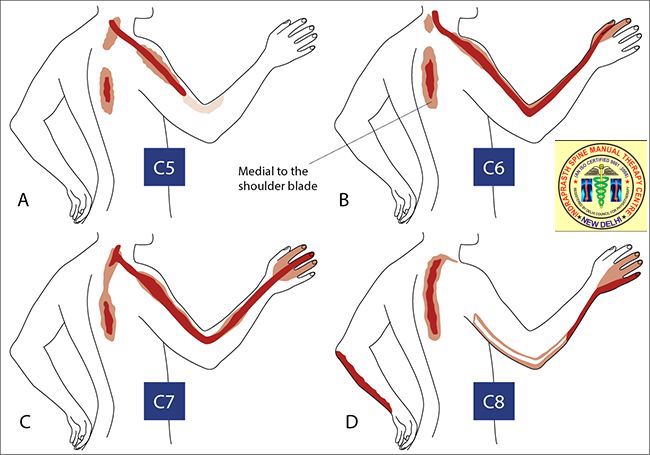
CERVICAL RADICULOPATHY - Cervical radiculopathy is the clinical description of pain and/or neurological symptoms resulting from any type of condition that irritates a nerve in the cervical spine. Cervical nerve roots, named C1 through C8, exit the cervical spine above the designated vertebral level at all levels except the last one. These cervical nerves then branch out to supply muscles that enable functioning of the shoulders, arms, hands, and fingers. They also carry sensory fibers to the skin that provide sensation.When any nerve root in the cervical spine is irritated through compression or inflammation, symptoms of pain, tingling, numbness, and/or weakness can radiate anywhere along that nerve's pathway into the shoulder, arm, and/or hand.

Cervical radiculopathy symptoms differ depending on which nerve is affected.

  • C5 radiculopathy can cause pain and/or weakness in the shoulders and upper arms. It especially may cause discomfort around the shoulder blades but rarely causes numbness or tingling.
  • C6 radiculopathy causes pain and/or weakness along the length of the arm, including the biceps, wrists, and the thumb and index finger.
  • C7 radiculopathy causes pain and/or weakness from the neck to the hand and can include the triceps and the middle finger.
  • C8 radiculopathy causes pain from the neck to the hand. Patients may experience weakness in hand grip, and pain and numbness can radiate along the inner side of the arm, ring, and little fingers.